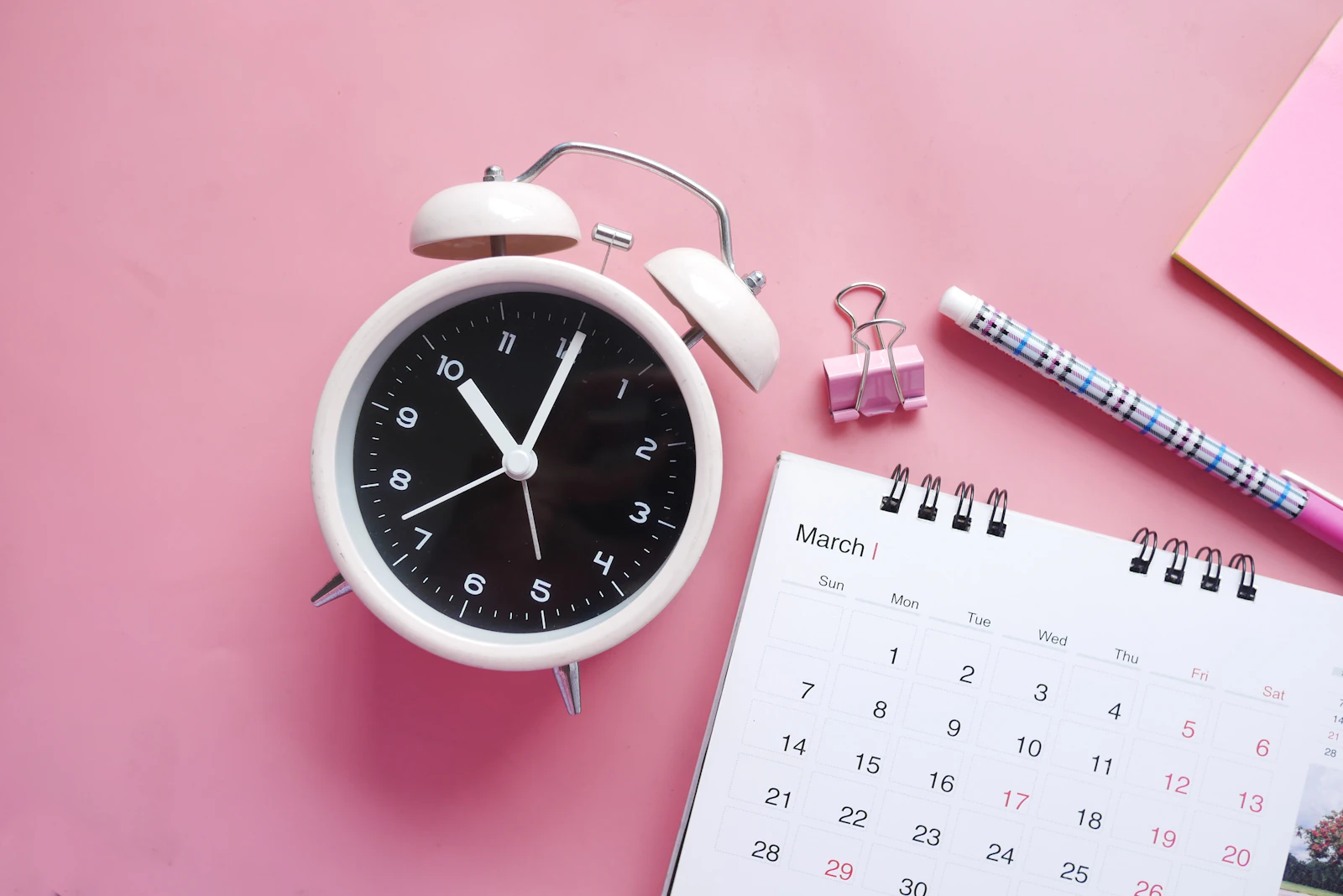
Twice a year, a large number of Americans go to bed unsure whether their alarm is about to betray them. The short version is that it will not — but the reasons are worth knowing, and there is one genuine edge case that does bite people.
The dates
In the United States, daylight saving time follows a fixed rule rather than a fixed date:
- Spring forward — the second Sunday in March, at 2:00 a.m. Clocks jump straight to 3:00 a.m. You lose an hour.
- Fall back — the first Sunday in November, at 2:00 a.m. Clocks return to 1:00 a.m. You gain an hour.
| Spring forward | Fall back | |
|---|---|---|
| 2026 | March 8 | November 1 |
| 2027 | March 14 | November 7 |
| 2028 | March 12 | November 5 |
Not everywhere observes it. Hawaii and most of Arizona stay on standard time year-round — the Navajo Nation within Arizona is the exception and does observe. Puerto Rico, the U.S. Virgin Islands, Guam, American Samoa and the Northern Mariana Islands do not observe it either. If you are in one of those places, none of this applies to you and your clocks simply do not move.
Proposals to make one or the other permanent come back to Congress regularly. Until one actually becomes law, the rule above is the rule.
Your alarm adjusts. You do not have to do anything.
iPhone alarms are stored as wall-clock times, not as a countdown. An alarm set for 6:30 a.m. means "whenever the phone says 6:30 a.m." — so when the phone's clock shifts, the alarm shifts with it. You do not need to change it, delete it, or re-create it.
This holds as long as Settings → General → Date & Time → Set Automatically is on, which it is by default. If somebody turned it off — usually to fake a time zone for a game, years ago — the phone will not shift, and everything about that weekend will be an hour wrong. That is the single most common cause of a genuinely mistimed alarm across a time change, and it is worth checking rather than assuming.
The same is true of a third-party alarm app built on the system's alarm framework, which is what iOS 26 made possible: the alarm is an object iOS owns, and iOS moves it.
The one real edge case: 2:00–2:59 a.m. in March
On the night the clocks spring forward, the hour between 2:00 and 3:00 a.m. does not exist. The clock goes from 1:59:59 straight to 3:00:00.
If you have an alarm set for, say, 2:30 a.m. on that specific Sunday, there is no moment at which it is 2:30 a.m. Behavior here varies by platform and by app — some fire at the shifted equivalent, some fire immediately after the jump, some skip that occurrence entirely. It is a genuinely ambiguous situation and there is no universally correct answer.
Most morning alarms sit outside this window. If you work an overnight shift and use a 2:00–2:59 a.m. alarm, move it outside that hour on the spring-forward night.
The November version is the mirror image and much more benign: 1:00–1:59 a.m. happens twice. An alarm in that window will typically fire once, on the first pass, which is what most people would want anyway.
The part that actually hurts
None of the above is why the time change is miserable. The clocks are handled. You are not.
Springing forward takes an hour out of the night on a fixed schedule regardless of when you went to bed. That is an acute, involuntary sleep debt — and sleep debt is not just tiredness. It pushes a larger share of the following nights into deep slow-wave sleep, which is the stage you are hardest to wake from. So the Monday after the spring change is not merely a morning where you got less sleep. It is a morning where your alarm has worse odds than it did on Friday.
This is measurable at national scale. Fritz and colleagues at the University of Colorado Boulder analysed 732,835 fatal crashes in the US Fatality Analysis Reporting System between 1996 and 2017 and found a 6% spike in fatal car accidents in the workweek after the spring change — about 28 additional deaths a year, 627 across the period studied. The increase starts on the Sunday itself, and the bulk of the extra fatal crashes happen in the morning. It is worse the further west you live within your time zone: past 8% on the western edge, where people already sleep about 19 minutes less per night on average.
Nobody is arguing that a national road-safety statistic is about alarm clocks. It is here because it is the clearest available evidence that the hour is not a rounding error — one hour, taken involuntarily, degrades human performance enough to show up in fatality counts. Your Monday morning is a small instance of the same effect.
That is why the week after the March change produces the year's crop of "I have never slept through my alarm before" stories. Nothing about the alarm changed. The odds did.
Falling back is easier, but not free: you get an hour, and then your body clock spends several days out of step with the light, which tends to show up as waking too early rather than sleeping through.
What actually helps around the change
Shift gradually. Moving your bedtime by fifteen minutes a night for the four nights before beats absorbing the whole hour at once. This is the only item here that genuinely works, and it requires deciding on Wednesday.
Get light early on the Sunday and Monday. Morning light is what drags the body clock into alignment. It matters more after the spring change than at any other point in the year.
Do not add a backup alarm five minutes after the first one. The instinct is understandable and it is the wrong move — it trains you to treat the first alarm as optional, which is the habituation problem you will be living with for the other 363 days.
Expect the Monday to be worse and plan around it rather than expecting willpower to cover the gap. Do not schedule the thing you cannot be late for on the Monday after the clocks move.
Sources
- Fritz, J., Vetter, C., et al. (2020). Reported in Spring forward to daylight saving time brings surge in fatal car crashes, University of Colorado Boulder, from the study published in Current Biology. Arizona and Indiana were excluded from the analysis because they did not consistently observe DST across the period.
- Patel, A. K., Reddy, V., Shumway, K. R., & Araujo, J. F. Physiology, Sleep Stages. StatPearls, NCBI Bookshelf. (Why lost sleep raises the share of the night spent in the hardest stage to wake from.)
- DST dates and the state and territory exemptions follow the Uniform Time Act as amended by the Energy Policy Act of 2005, which set the current second-Sunday-in-March / first-Sunday-in-November rule.
Fifi is an alarm built on Apple's AlarmKit, so it shifts with the clock the way the system Clock does — and instead of fading out as a tone it hands you over to a character who talks, which is a design aimed squarely at the mornings where the odds are against you. Fifi is available now for iPhone on the App Store.