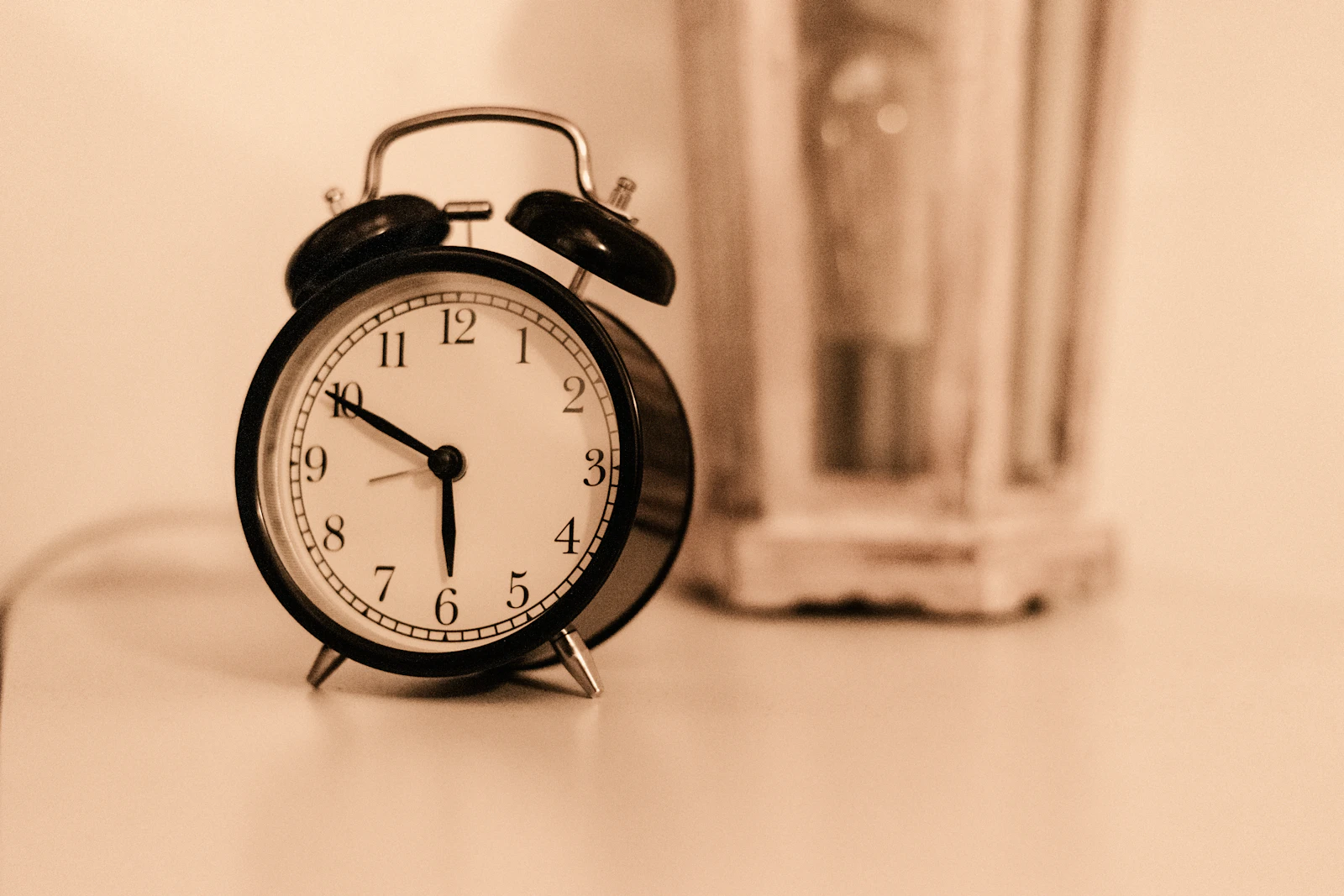
The intuitive fix for sleeping through an alarm is make it louder. It works for a week or two, then stops, and you are back where you started with a worse relationship to mornings.
There is a hard ceiling on that approach, and it is documented: in deep slow-wave sleep, "for some people, loud noises (> 100 decibels) will not lead to an awake state." A hundred decibels is a chainsaw at arm's length. Whatever your phone is doing, it is not doing that — and if it were, the problem would be your neighbours, not your mornings.
Volume is not the variable. Here is what is.
1. Unpredictability
Your brain filters out repeated stimulus that reliably means nothing — that is habituation, and it is the single largest reason a working alarm stops working. Anything that keeps the stimulus from settling into a learnable pattern resists it:
- Sound that is not identical every morning.
- Content that is not identical every morning — words carry more variation than a tone ever can.
- Timing that varies within a window rather than landing on the same minute.
This is also why loudness fails specifically. A louder version of the same predictable sound is still the same predictable sound. You habituate to it at the new volume, just slightly more slowly.
2. Social weight
Almost nobody sleeps through a phone call from a person they know. Very many people sleep through a marimba.
That gap is not about decibels — a ringtone is often quieter than an alarm. It is that a call implies someone is on the other end, waiting. Human attention systems treat a social demand differently from an environmental noise, and they do it below the level of conscious decision. You do not decide the call matters more. It simply gets through a filter the alarm does not.
The practical version: an alarm that carries a voice — one that addresses you, expects something, and behaves like a person rather than a tone — is working with that mechanism rather than against it. An alarm that beeps is competing with the refrigerator.
3. A dismissal that costs something
Sleep inertia leaves you capable of simple motor actions and not much else — which is precisely enough to find and press a large button, and not enough to make a considered decision. Any alarm whose off switch is a single tap will be defeated by a half-asleep person on autopilot, often with no memory of it afterwards.
The counter is to raise the floor above what autopilot can do. Different apps have taken this in different directions: math problems, barcode scanning, shaking, photographing a specific place in your home. They all work on the same principle — put a task between the sleeper and silence that requires actual cognition or getting out of bed.
There is a trade-off worth naming honestly. Aggressive dismissal tasks work, and a lot of people hate them, and the ones people hate get uninstalled in the second week. An alarm you disable is worse than a mild alarm you keep.
What does not work
Louder, alone. See above.
Multiple alarms five minutes apart. This is snoozing with extra steps, and it teaches your brain that the first several alarms are safe to ignore — actively training the habituation you are trying to defeat.
Putting the phone across the room, on its own. It helps, genuinely, because it forces standing up. But it fails silently the first morning you are groggy enough to walk over, dismiss it, and go back to bed — and it fails permanently the week you decide you are too cold to try.
A new alarm tone. Works for two weeks. Resets habituation's clock without changing anything structural.
Where this leads
If the mechanism is unpredictability plus social weight plus a costly dismissal, then the design that satisfies all three at once is not a louder beep. It is something that arrives like an incoming call, has a person on the other end, says something different every day, and cannot be dealt with by one thumb in the dark.
That is the shape Fifi is built to. The alarm is a real iPhone system alarm titled “Fifi is calling”; stop it, and a character talks you through the weather, the day's headlines, and a voice note if you left one — different words every morning. Fifi is available now for iPhone on the App Store.
Sources
- Patel, A. K., Reddy, V., Shumway, K. R., & Araujo, J. F. Physiology, Sleep Stages. StatPearls, NCBI Bookshelf. (Arousal threshold in N3 and the >100 dB figure.)
- Sundelin, T., Landry, S., & Axelsson, J. (2024). Is snoozing losing? Journal of Sleep Research, 33(3), e14054. (Why the "multiple alarms five minutes apart" point above is weaker than it looks — see the summary of the snooze evidence.)
One practical constraint sits underneath all of this on iPhone: whether an alarm app can even make a sound when your phone is muted or in Focus. For years, most could not. See does the iPhone alarm ring on silent.